MTest.MTest allows defining nonlinear constraints involving
gradients and thermodynamic forces.
This document details the derivation of the Lagrange multiplier in
MTest and the usage of the
@NonLinearConstraint keyword.
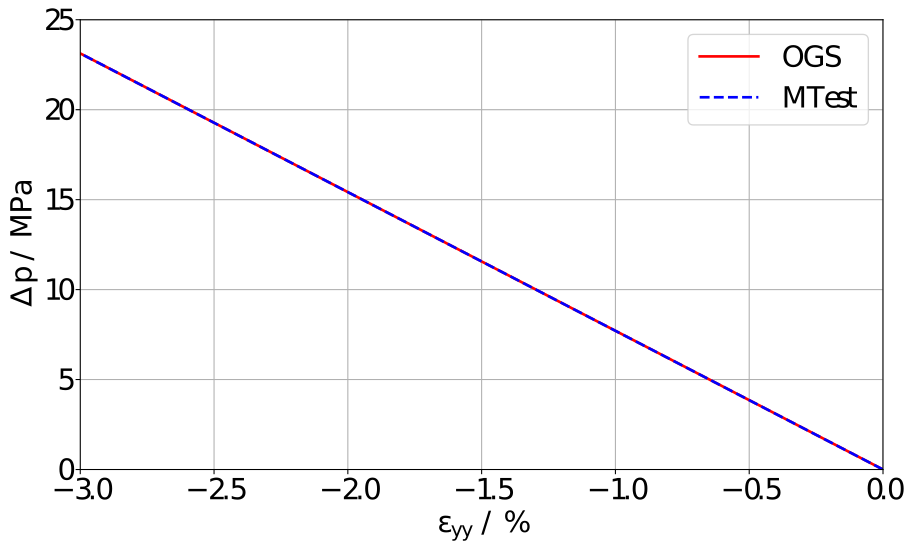
A detailed example is then presented, showing how to compute the pore pressure under undrained conditions through the Lagrange multiplier. The undrained condition leads to an effectively incompressible material response, characterised by zero volumetric strain. The Lagrange multiplier corresponding to the zero-volumetric-strain constraint is obtained by minimising the free energy function and can be interpreted as a pore pressure. The resulting pore pressure is then compared with the pore pressure computed using OpenGeoSys.
In general, this approach can be used to interpret Lagrange multipliers associated with constraints physically.
Note
The latest version of the documentation is available on the command line
mtest --help-keyword=@NonLinearConstraint
The @NonLinearConstraint keyword let the user introduce
arbitrary constraints on driving variables and thermodynamic forces.
A constraint \(c\) is imposed by introducing a Lagrange multiplier \(\lambda\).
Consider a small strain elastic behaviour characterised by its free energy \(\Psi\). In the only loading is the constraint \(c\), the solution satisfies: \[ \underset{\underline{\varepsilon},\lambda}{\min}\Psi-\lambda\,c \]
In this case, the constraint \(c\) is equivalent to the following imposed stress:
\[ -\lambda\,\frac{\partial c}{\partial \underline{\varepsilon}} \]
If the constraint is \(\sigma_{xx}-\sigma_{0}\), where \(\sigma_{0}\) is a constant value, the previous equation shows that imposing this constraint is not equivalent to imposing an uniaxial stress state \(\left(\sigma_{xx}\,0\,0\,0\,0\,0\right)\).
This keyword must be followed by an option giving the normalisation policy. The normalisation policy can have one of the following values:
DrivingVariable, Strain,
DeformationGradient, OpeningDisplacement
stating that the constraint is of the order of magnitude of the driving
variable.ThermodynamicForce, Stress,
CohesiveForce stating that the constraint is of the order
of magnitude of the thermodynamic force.The following line imposes the a constant stress triaxiality (assuming no shear stress components):
@Real 'B' '0.4';
@NonLinearConstraint<Stress> 'SYY - B * SXX';
@NonLinearConstraint<Stress> 'SZZ - B * SXX';
The following line imposes that the determinant of the deformation gradient remains equal to \(1\):
// ensure that the loading is isochoric in 1D
@NonLinearConstraint<DeformationGradient> 'FRR*FTT*FZZ-1';
The following line imposes the value of the first Piola-Kirchhoff stress (in 1D):
// impose the first piola kirchhoff stress
// in an uniaxial compression test
@Real 'Pi0' -40e6
@NonLinearConstraint<Stress> 'SXX*FYY*FZZ-Pi0';
@NonLinearConstraint<Stress> 'SYY';
@NonLinearConstraint<Stress> 'SZZ';
@NonLinearConstraint<Stress> 'SXY';
@NonLinearConstraint<Stress> 'SXZ';
@NonLinearConstraint<Stress> 'SYZ';A stress component whose value is imposed using
@ImposedStress command shall not appear in a non linear
constraint: the numerical treatment of those two constraints is
incompatible.
MTestThis section describe how nonlinear contraints can be used to model undrained compression tests. We highlight how the Lagrange multiplier \(\lambda\) is computed and its relation to the pore pressure \(p\).
The undrained condition refers to a loading process in which no fluid is allowed to enter or leave the porous medium, so the total fluid mass (or fluid content) in the system remains constant during deformation. As a result, changes in stress are accompanied by changes in pore pressure rather than fluid flow, leading to effective material properties that differ from drained ones. Hooke’s law for an isotropic elastic body, representing the strain-effective stress relations in the theory of poro-elasticity taking into account the effect of the pore pressure on total stress is given as follows (only normal components) [1]: \[ \begin{aligned} \varepsilon_{xx} &= \frac{\sigma_{xx}}{E} - \frac{1-\nu}{E}\left( \sigma_{yy} + \sigma_{zz} \right) + \frac{\Delta\, p}{3H}, \\[1.5ex] \varepsilon_{yy} &= \frac{\sigma_{yy}}{E} - \frac{1-\nu}{E}\left( \sigma_{xx} + \sigma_{zz} \right) + \frac{\Delta\,p}{3H}, \\[1.5ex] \varepsilon_{zz} &= \frac{\sigma_{zz}}{E} - \frac{1-\nu}{E}\left( \sigma_{xx} + \sigma_{yy} \right) + \frac{\Delta\,p}{3H}, \end{aligned} \] where \(\dfrac{1}{H}\) is an additional parameter that denotes the poroelastic expansion coefficient, and determined as: \[ \cfrac{1}{H}= \cfrac{3 \left( 1 - 2\nu\right) \alpha}{2 \left( 1 + \nu\right) G} \quad \mathrm{with} \quad G = \frac{E}{2 \left( 1 + \nu\right)} \label{H_coeff} \]
Moreover, the variation in water content is given as a function of the volumetric strain as follows[1]: \[ \zeta = \alpha\, \mathrm{tr} \boldsymbol{\varepsilon}+ \cfrac{\Delta p}{Q}, \label{variation_in_water_content} \] where \[ \cfrac{1}{Q} = \cfrac{1}{R} - \cfrac{\alpha}{H}. \] It is a measure of the amount of water which can be forced into the soil under pressure while the volume of the soil is kept constant. \(Q\) is called the Biot’s modulus in the literature [1].
In a more standard notation, these constitutive relations are written as: \[ \boldsymbol{\sigma} = \boldsymbol{\sigma}^{\mathrm{eff}}-\alpha p \boldsymbol{I} \quad \mathrm{with} \quad \boldsymbol{\sigma}^{\mathrm{eff}} = K\,\mathrm{tr}\left( \boldsymbol{\varepsilon }\right) + 2\,G\,\boldsymbol{\varepsilon}^{\mathrm{dev}} \quad \mathrm{and} \quad \boldsymbol{\varepsilon}^{\mathrm{dev}} - \cfrac{\mathrm{tr}(\boldsymbol{\varepsilon})}{3}\,\boldsymbol{I}, \] by considering an effective free energy function of the form: \[ \psi(\boldsymbol{\varepsilon}) = \cfrac{1}{2}\,K\, \mathrm{tr}^{2}\left(\boldsymbol{\varepsilon}\right) + G\,\boldsymbol{\varepsilon}^{\mathrm{dev}}:\boldsymbol{\varepsilon}^{\mathrm{dev}}, \] where the bulk and the shear moduli are calculated as: \[ K = \cfrac{E}{3\,(1-2\,\nu)} \quad \mathrm{with} \quad G=\cfrac{E}{2\,\left( 1+\nu \right)}. \]
We now consider an unconfined uniaxial compression test controlled by \(\varepsilon_{yy}=-\delta\,t\) under undrained conditions and an incompressible fluid. This condition amounts to an isochoric test, so we need to enforce \(\epsilon:=\mathrm{tr}\varepsilon=0\). To obtain the Lagrange multiplier associated with material incompressibility, the stationary point of the energy complemented by two constraints and the work of the external stresses is sought: \[ \varepsilon_{xx} + \varepsilon_{yy} + \varepsilon_{zz} = 0, \quad \mathrm{and} \quad \sigma_{xx} = \sigma_{zz}. \] The Lagrangian of the system reads: \[ \mathcal{L} = \frac{1}{2}K\,\mathrm{tr}^{2}(\boldsymbol{\varepsilon}) + G\,\boldsymbol{\varepsilon}^{\mathrm{dev}}:\boldsymbol{\varepsilon}^{\mathrm{dev}} - \lambda_1\,\mathrm{tr}(\boldsymbol{\varepsilon}) - \lambda_2 \left( \sigma_{xx} - \sigma_{zz} \right) - \boldsymbol{\sigma} : \boldsymbol{\varepsilon}, \] where \(\lambda_1\), \(\lambda_2\) are the Lagrange multipliers associated with the volumetric strain constraint and the stress constraint, respectively. The stationarity conditions are obtained by taking the first variations of the Lagrangian with respect to the unknown strain components and the Lagrange multipliers.
We introduce the deviatoric projector \[ \mathbf{A} = \mathbf{e}_x \otimes \mathbf{e}_x - \mathbf{e}_z \otimes \mathbf{e}_z, \qquad \sigma_{xx} - \sigma_{zz} = \boldsymbol{\sigma} : \mathbf{A}. \]
The variation with respect to the strain tensor yields \[ \delta_\varepsilon \mathcal{L} = \left( K\,\mathrm{tr}(\boldsymbol{\varepsilon})\,\mathbf{I} + 2G\,\boldsymbol{\varepsilon}^{\mathrm{dev}} - \lambda_1\,\mathbf{I} - 2G\,\lambda_2\,\mathbf{A} - \boldsymbol{\sigma} \right) : \delta \boldsymbol{\varepsilon} = 0, \] which must hold for all \(\delta\boldsymbol{\varepsilon}\) and thus implies \[ K\,\mathrm{tr}(\boldsymbol{\varepsilon})\,\mathbf{I} + 2G\,\boldsymbol{\varepsilon}^{\mathrm{dev}} - \lambda_1\,\mathbf{I} - 2G\,\lambda_2\,\mathbf{A} - \boldsymbol{\sigma} = \mathbf{0}. \]
The variations with respect to the Lagrange multipliers give the constraints \[ \delta_{\lambda_1} \mathcal{L} = -\mathrm{tr}(\boldsymbol{\varepsilon})\,\delta \lambda_1 = 0, \qquad \delta_{\lambda_2} \mathcal{L} = -(\sigma_{xx} - \sigma_{zz})\,\delta \lambda_2 = 0, \] so that \[ \mathrm{tr}(\boldsymbol{\varepsilon}) = 0, \qquad \sigma_{xx} = \sigma_{zz}. \]
From the stationarity condition with respect to \(\boldsymbol{\varepsilon}\) we can express the (given) stress tensor as \[ \boldsymbol{\sigma} = K\,\mathrm{tr}(\boldsymbol{\varepsilon})\,\mathbf{I} + 2G\,\boldsymbol{\varepsilon}^{\mathrm{dev}} - \lambda_1\,\mathbf{I} - 2G\,\lambda_2\,\mathbf{A}. \] Using the result of the first constraint, \(\mathrm{tr}(\boldsymbol{\varepsilon}) = 0\), this simplifies to \[ \boldsymbol{\sigma} = 2G\,\boldsymbol{\varepsilon}^{\mathrm{dev}} - \lambda_1\,\mathbf{I} - 2G\,\lambda_2\,\mathbf{A}. \]
For a uniaxial compression test with \(\varepsilon_{yy}\) as the control variable, the volumetric constraint \[ \mathrm{tr}(\boldsymbol{\varepsilon}) = \varepsilon_{xx} + \varepsilon_{yy} + \varepsilon_{zz} = 0 \] together with the symmetry condition \(\varepsilon_{xx} = \varepsilon_{zz}\) yields \[ \varepsilon_{xx} = \varepsilon_{zz} = -\frac{1}{2}\,\varepsilon_{yy}. \]
Inserting this strain state into the stationarity condition \[ \sigma_{ij} = 2G\,\varepsilon_{ij}^{\mathrm{dev}} - \lambda_1\,\delta_{ij} - 2G\,\lambda_2\,A_{ij}, \qquad A_{ij} = \mathrm{diag}(1,0,-1), \] gives the componentwise relations \[\begin{align} \sigma_{xx} &= 2G\,\varepsilon_{xx} - \lambda_1 - 2G\,\lambda_2,\\ \sigma_{yy} &= 2G\,\varepsilon_{yy} - \lambda_1,\\ \sigma_{zz} &= 2G\,\varepsilon_{zz} - \lambda_1 + 2G\,\lambda_2. \end{align}\]
The second constraint, \(\sigma_{xx} = \sigma_{zz}\), then reduces to \[ -2G\,\lambda_2 = +2G\,\lambda_2 \qquad\Longrightarrow\qquad \lambda_2 = 0. \]
For a uniaxial test the lateral stresses vanish, \[ \sigma_{xx} = \sigma_{zz} = 0. \] Using \(\lambda_2=0\) and \(\varepsilon_{xx} = -\tfrac12\varepsilon_{yy}\) in \(\sigma_{xx} = 2G\varepsilon_{xx} - \lambda_1\) gives \[ 0 = 2G\!\left(-\frac{1}{2}\varepsilon_{yy}\right) - \lambda_1, \qquad\Longrightarrow\qquad \lambda_1 = -G\,\varepsilon_{yy}. \]
Thus, the Lagrange multipliers for the uniaxial compression case are \[ \boxed{ \lambda_1 = -G\,\varepsilon_{yy}, \qquad \lambda_2 = 0. } \]
Finally, the resulting axial stress follows as \[ \sigma_{yy} = 2G\,\varepsilon_{yy} - \lambda_1 = 3G\,\varepsilon_{yy}. \]
MTestBy default, the Lagrange multiplier is scaled by the maximum absolute
value of the components of the stiffness tensor with the
Strain normalization policy at the first resolution.
In the presented example, the scaling factor is \(K+\cfrac{4\,G}{3}\), which is the first component of the elastic stiffness.
Finally, we get: \[ \lambda^{*}_1 = \cfrac{\lambda_1}{K + 4\,G/3} \]
The Lagrange multiplier \(\lambda_1\) represents the pore pressure under undrained conditions, i.e. \(p=\lambda_1\).
Note
Rather than relying on
MTest’s choice on the normalization factor, one may choose an appropriate one and use theStressnormalization policy, as follows:@Real 'c' '70e9'; @NonLinearConstraint<Stress> 'c * (EXX + EYY + EZZ)';
The comparison between the pore pressure obtained with OpenGeoSys and the
Lagrange multiplier computed with MTest is presented in
Figure 1.
MTest.