Loading...
Searching...
No Matches
numodis::FCC Struct Reference
FCC crystallography handler using the Wigner-Seitz cell. More...
#include </home/runner/work/tfel/tfel/include/NUMODIS/FCC.hxx>
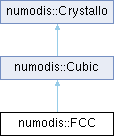
Inheritance diagram for numodis::FCC:
Public Member Functions | |
| FCC (FCC &&) noexcept | |
| FCC (const FCC &) | |
| Public Member Functions inherited from numodis::Cubic | |
| Cubic (Cubic &&) noexcept | |
| Cubic (const Cubic &) | |
| Vect3 | direction (const IDirection &) const override |
| Vect3 | burgers_vector (const IBurgers &) const override |
| Vect3 | normal (const IPlane &) const override |
| double | Norm2 (const IBurgers &iburgers) const override |
| int | getNsymmetries () const override |
| GSystem | Symmetry (int k, const GSystem &gsystem) const override |
| void | GenerateEquivalentIndices (const std::vector< int > &ind0, std::vector< std::vector< int > > &equivalent) const override |
| void | GenerateOrthogonalVector (const IPlane &u, IDirection &v) const override |
| Find a vector v orthogonal to u. | |
| void | CrossProduct (const IPlane &iplane1, const IPlane &iplane2, IDirection &idirection) const override |
| Compute the cross product of two plane normals. | |
| void | CrossProduct (const IBurgers &iburgers, const IDirection &idirection, IPlane &iplane) const override |
| Compute the cross product of a Burgers and a direction. | |
| void | CrossProduct (const IDirection &idirection0, const IDirection &idirection1, IDirection &idirection2) const |
| int | ScalProduct (const IPlane &iplane, const IBurgers &iburgers) const override |
| Compute the scalar product of a IPlane * IBurgers. | |
| int | ScalProduct (const IPlane &iplane, const IDirection &idirection) const override |
| Compute the scalar product of a IPlane * IDirection. | |
| int | ScalProduct (const IDirection &idirection0, const IDirection &idirection1) const |
| Compute the scalar product of two IDirections. | |
| bool | SamePlaneFamily (const IPlane &iplane0, const IPlane &iplane1) const override |
| Return true if two planes are equivalent. | |
| bool | SameBurgersFamily (const IBurgers &iburgers0, const IBurgers &iburgers1) const override |
| Return true if two Burgers are equivalent. | |
| bool | SameGlideSystem (const IPlane &iplane0, const IBurgers &iburgers0, const IPlane &iplane1, const IBurgers &iburgers1) const override |
| Public Member Functions inherited from numodis::Crystallo | |
| Crystallo (Crystallo &&) noexcept | |
| Crystallo (const Crystallo &) | |
| GSystem | InitGSystem (const IBurgers &iburgers, const IPlane &iplane) const |
| virtual void | GenerateEquivalentIBurgers (const IBurgers &iburgers, std::vector< IBurgers > &eqiburgers) const |
| virtual void | GenerateEquivalentPlanes (const IPlane &iplane, std::vector< IPlane > &planes) const |
| virtual void | GenerateEquivalentGSystems (const GSystem &gsystem, std::vector< GSystem > &allGSystems) const |
| virtual GSystem | ComputeJunctionGSystem (const GSystem &gsystem1, const GSystem &gsystem2) const |
| const std::string & | PrintName () const |
| Returns the name of the Crystallo handler. | |
| virtual int | getNindices () const |
| Returns the number of indices used for discrete coordinates. | |
| bool | Collinear (const IDirection &idirection1, const IDirection &idirection2) const |
| Determine whether two directions are collinear or not. | |
| const std::string | getName () const |
Additional Inherited Members | |
| Protected Member Functions inherited from numodis::Cubic | |
| std::vector< int > | Symmetry (int k, const std::vector< int > &indices) const |
| Protected Attributes inherited from numodis::Crystallo | |
| std::string | _name |
| name of the class | |
| std::vector< Vect3 > | _alattice |
| basis used to compute atomic positions and directions | |
| std::vector< Vect3 > | _blattice |
| basis used to compute Burgers' vector | |
| std::vector< Vect3 > | _plattice |
| basis used to compute plane normal | |
Detailed Description
FCC crystallography handler using the Wigner-Seitz cell.
FCC handles Face-Centered Cubic crystallographic structures using the Wigner-Seitz cell.
The unit vectors \(\mathbf{a}_1\), \(\mathbf{a}_2\) and \(\mathbf{a}_3\) are defined as follows:

FCC unit vectors
The discrete position \(\mathbf{r}\) of a node is defined by a triplet of integer \((i,j,k)\) such that:
\[\mathbf{r} = i \mathbf{a}_1 + j \mathbf{a}_2 + k \mathbf{a}_3 \]
Following an idea similar to forbidden reflections used in crystallography, a triplet \((i,j,k)\) is admissible if and only if \( i+j+k=0\bmod{2} \).
The documentation for this struct was generated from the following file: