|
| std::vector< OptionDescription > | getOptions () const override |
| void | initialize (BehaviourDescription &, AbstractBehaviourDSL &, const std::string &, const DataMap &) override |
|
| ~PlasticInelasticFlow () override |
| | destructor
|
| void | setPorosityEvolutionHandled (const bool) override |
| | set a flag stating if the porosity evolution is handled by the brick. This shall always be the case if the inelastic flow is coupled with the porosity evolution. This method is called after that all the other flows handled by this brick are initialized.
|
| bool | isCoupledWithPorosityEvolution () const override |
| void | endTreatment (BehaviourDescription &, const AbstractBehaviourDSL &, const StressPotential &, const std::string &) const override |
| | method called at the end of the input file processing
|
| void | completeVariableDeclaration (BehaviourDescription &, const AbstractBehaviourDSL &, const std::string &) const override |
| | complete the variable description
|
| bool | requiresActivationState () const override |
| | returns if the flow requires an activation state for the resolution.
|
|
void | computeInitialActivationState (BehaviourDescription &, const StressPotential &, const std::string &) const override |
| std::string | updateNextEstimateOfThePorosityIncrement (const BehaviourDescription &, const std::string &) const override |
| | add the intialization of the activation state of the BehaviourData::BeforeInitializeLocalVariables code block.
\note at this stage, the stress potential has already been called and
the elastic prediction of the stress sigel` is available.
|
| std::string | updatePorosityUpperBound (const BehaviourDescription &, const std::string &) const override |
|
| ~InelasticFlowBase () override |
| | destructor
|
|
| double | maximum_equivalent_stress_factor = -1 |
| | maximum equivalent stress factor
|
|
double | equivalent_stress_check_maximum_iteration_factor = 0.5 |
| | a factor which gives the maximum number of iterations below which the check on the maximum equivalent stress is performed.
|
|
std::shared_ptr< StressCriterion > | sc |
| | stress criterion
|
|
std::shared_ptr< StressCriterion > | fc |
| | flow criterion
|
|
std::vector< std::shared_ptr< IsotropicHardeningRule > > | ihrs |
| | isotropic hardening rules
|
|
std::vector< std::shared_ptr< KinematicHardeningRule > > | khrs |
| | kinematic hardening rules
|
| PorosityEffectOnFlowRule | porosity_effect_on_equivalent_plastic_strain |
| | Effect of the porosity on the flow rule.
|
| PorosityEvolutionAlgorithm | porosity_evolution_algorithm |
| | algorithm used to handle the porosity evolution
|
| double | cosine_threshold = 2 |
| | minimum value of the cosine of the angle between two successive estimates of the flow direction. If the computed angle is lower than this threshold, the Newton step is rejected.
|
|
double | cosine_check_minimum_iteration_factor = 0 |
| | a factor \(alpha\) which gives the threshold below which the check on the cosine of the angle between two successive estimates of the flow direction is performed, i.e. the test is performed if the iteration counter is greater than \(alpha \cdot
i_{\max{}}\) where \(i_{\max{}}\) is the maximum number of iterations.
|
|
double | cosine_check_maximum_iteration_factor = 1 |
| | a factor \(alpha\) which gives the threshold upper which the check on the cosine of the angle between two successive estimates of the flow direction is performed, i.e. the test is performed if the iteration counter is below \(alpha \cdot
i_{\max{}}\) where \(i_{\max{}}\) is the maximum number of iterations.
|
|
bool | porosity_evolution_explicitely_handled = false |
| | flag stating that the porosity evolution is handled by the brick
|
|
bool | save_porosity_increase = false |
| | flag stating if the contribution to the porosity growth associated with this flow, if any, must be saved in a dedicated auxiliary state variable.
|
| std::string | equivalent_strain_external_name |
| | external name of equivalent strain.
|
|
bool | save_stress_criterion = false |
| | flag stating if the equivalent stress at the middle of the time step must be saved in a dedicated auxiliary state variable.
|
| std::string | stress_criterion_external_name |
| | external name of the auxiliary state variable in which the stress criterion shall be saved if save_stress_criterion is true.
|
|
bool | save_yield_surface_radius = false |
| | flag stating if the yield surface radius at the middle of the time step must be saved in a dedicated auxiliary state variable.
|
| std::string | yield_surface_radius_external_name |
| | external name of the auxiliary state variable in which the yield surface radius shall be saved if save_yield_surface_radius is true.
|
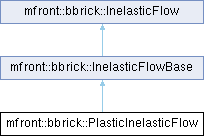
describe an inelastic flow defined by a plastic law.
- Note
- the base class must declare a state variable named p+id.
| double mfront::bbrick::PlasticInelasticFlow::maximum_equivalent_stress_factor = -1 |
|
protected |
maximum equivalent stress factor
A factor, denoted \(alpha\) in this description, which gives the maximal equivalent stress allowed before damping the current Newton step. This maximal equivalent stress is defined as \(alpha * R\) where \(R\) is the current elastic limit. \(alpha\) must be greater than one.
If \(alpha\) is lower than one, which is the default, the code performing this check is not generated.