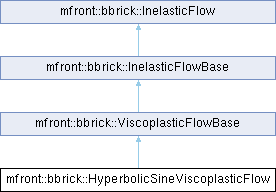
describe an inelastic flow defined by a Norton law. More...
#include </home/runner/work/tfel/tfel/mfront/include/MFront/BehaviourBrick/HyperbolicSineViscoplasticFlow.hxx>
Public Member Functions | |
| void | initialize (BehaviourDescription &, AbstractBehaviourDSL &, const std::string &, const DataMap &) override |
| void | endTreatment (BehaviourDescription &, const AbstractBehaviourDSL &, const StressPotential &, const std::string &) const override |
| method called at the end of the input file processing | |
| std::vector< OptionDescription > | getOptions () const override |
| ~HyperbolicSineViscoplasticFlow () override | |
| destructor | |
| Public Member Functions inherited from mfront::bbrick::ViscoplasticFlowBase | |
| void | initialize (BehaviourDescription &, AbstractBehaviourDSL &, const std::string &, const DataMap &) override |
| ~ViscoplasticFlowBase () override | |
| destructor | |
| Public Member Functions inherited from mfront::bbrick::InelasticFlowBase | |
| void | setPorosityEvolutionHandled (const bool) override |
| set a flag stating if the porosity evolution is handled by the brick. This shall always be the case if the inelastic flow is coupled with the porosity evolution. This method is called after that all the other flows handled by this brick are initialized. | |
| bool | isCoupledWithPorosityEvolution () const override |
| void | endTreatment (BehaviourDescription &, const AbstractBehaviourDSL &, const StressPotential &, const std::string &) const override |
| method called at the end of the input file processing | |
| void | completeVariableDeclaration (BehaviourDescription &, const AbstractBehaviourDSL &, const std::string &) const override |
| complete the variable description | |
| std::vector< OptionDescription > | getOptions () const override |
| bool | requiresActivationState () const override |
| returns if the flow requires an activation state for the resolution. | |
| void | computeInitialActivationState (BehaviourDescription &, const StressPotential &, const std::string &) const override |
| std::string | updateNextEstimateOfThePorosityIncrement (const BehaviourDescription &, const std::string &) const override |
| add the intialization of the activation state of the BehaviourData::BeforeInitializeLocalVariables code block.
\note at this stage, the stress potential has already been called and
the elastic prediction of the stress sigel` is available. | |
| std::string | updatePorosityUpperBound (const BehaviourDescription &, const std::string &) const override |
| ~InelasticFlowBase () override | |
| destructor | |
Protected Member Functions | |
| bool | describesStrainHardeningExplicitly () const override |
| std::string | computeFlowRate (const BehaviourDescription &, const StressPotential &, const std::string &) const override |
| compute the strain rate "vp"+id | |
| std::string | computeFlowRateAndDerivative (const BehaviourDescription &, const StressPotential &, const std::string &) const override |
| Protected Member Functions inherited from mfront::bbrick::ViscoplasticFlowBase | |
| std::string | buildFlowImplicitEquations (const BehaviourDescription &, const StressPotential &, const std::string &, const bool) const override |
| Protected Member Functions inherited from mfront::bbrick::InelasticFlowBase | |
| virtual void | checkOptions (const DataMap &) const |
| check the validity of the options passed | |
| virtual PorosityEffectOnFlowRule | getPorosityEffectOnEquivalentPlasticStrain () const |
| virtual bool | contributesToPorosityGrowth () const |
| virtual void | addFlowContributionToTheImplicitEquationAssociatedWithPorosityEvolution (CodeBlock &, const BehaviourDescription &, const AbstractBehaviourDSL &, const StressPotential &, const std::string &) const |
| add the contribution of this inelastic flow to the implicit equation associated with the porosity evolution. | |
| virtual std::string | computeEffectiveStress (const std::string &id) const |
| compute the effective stress at \(t+\theta\,dt\). | |
Protected Attributes | |
| BehaviourDescription::MaterialProperty | A |
| A coefficient. | |
| BehaviourDescription::MaterialProperty | K |
| K coefficient. | |
| BehaviourDescription::MaterialProperty | n |
| Norton exponent. | |
| BehaviourDescription::MaterialProperty | Ksf |
| stress threshold factor (optional). | |
| Protected Attributes inherited from mfront::bbrick::InelasticFlowBase | |
| std::shared_ptr< StressCriterion > | sc |
| stress criterion | |
| std::shared_ptr< StressCriterion > | fc |
| flow criterion | |
| std::vector< std::shared_ptr< IsotropicHardeningRule > > | ihrs |
| isotropic hardening rules | |
| std::vector< std::shared_ptr< KinematicHardeningRule > > | khrs |
| kinematic hardening rules | |
| PorosityEffectOnFlowRule | porosity_effect_on_equivalent_plastic_strain |
| Effect of the porosity on the flow rule. | |
| PorosityEvolutionAlgorithm | porosity_evolution_algorithm |
| algorithm used to handle the porosity evolution | |
| double | cosine_threshold = 2 |
| minimum value of the cosine of the angle between two successive estimates of the flow direction. If the computed angle is lower than this threshold, the Newton step is rejected. | |
| double | cosine_check_minimum_iteration_factor = 0 |
| a factor \(alpha\) which gives the threshold below which the check on the cosine of the angle between two successive estimates of the flow direction is performed, i.e. the test is performed if the iteration counter is greater than \(alpha \cdot
i_{\max{}}\) where \(i_{\max{}}\) is the maximum number of iterations. | |
| double | cosine_check_maximum_iteration_factor = 1 |
| a factor \(alpha\) which gives the threshold upper which the check on the cosine of the angle between two successive estimates of the flow direction is performed, i.e. the test is performed if the iteration counter is below \(alpha \cdot
i_{\max{}}\) where \(i_{\max{}}\) is the maximum number of iterations. | |
| bool | porosity_evolution_explicitely_handled = false |
| flag stating that the porosity evolution is handled by the brick | |
| bool | save_porosity_increase = false |
| flag stating if the contribution to the porosity growth associated with this flow, if any, must be saved in a dedicated auxiliary state variable. | |
| std::string | equivalent_strain_external_name |
| external name of equivalent strain. | |
| bool | save_stress_criterion = false |
| flag stating if the equivalent stress at the middle of the time step must be saved in a dedicated auxiliary state variable. | |
| std::string | stress_criterion_external_name |
| external name of the auxiliary state variable in which the stress criterion shall be saved if save_stress_criterion is true. | |
| bool | save_yield_surface_radius = false |
| flag stating if the yield surface radius at the middle of the time step must be saved in a dedicated auxiliary state variable. | |
| std::string | yield_surface_radius_external_name |
| external name of the auxiliary state variable in which the yield surface radius shall be saved if save_yield_surface_radius is true. | |
Additional Inherited Members | |
| Public Types inherited from mfront::bbrick::InelasticFlow | |
| using | Data = tfel::utilities::Data |
| a simple alias | |
| using | DataMap = tfel::utilities::DataMap |
| a simple alias | |
| using | ModellingHypothesis = tfel::material::ModellingHypothesis |
| a simple alias | |
| using | Hypothesis = ModellingHypothesis::Hypothesis |
| a simple alias | |
| using | MaterialPropertyInput = BehaviourDescription::MaterialPropertyInput |
| a simple alias | |
| Protected Types inherited from mfront::bbrick::InelasticFlowBase | |
| enum | PorosityEffectOnFlowRule { UNDEFINED_POROSITY_EFFECT_ON_EQUIVALENT_PLASTIC_STRAIN , NO_POROSITY_EFFECT_ON_EQUIVALENT_PLASTIC_STRAIN , STANDARD_POROSITY_CORRECTION_ON_EQUIVALENT_PLASTIC_STRAIN } |
| policy on how the porosity affects the flow rule More... | |
Detailed Description
describe an inelastic flow defined by a Norton law.
The Norton law is defined by the following associated flow rule:
\[\underline{\dot{\varepsilon}}^{\mathrm{vp}}= A\,\sinh^{n}\left(\frac{\left<\phi\left(\underline{\sigma}-\displaystyle\sum_{i}\underline{X}_{i}\right)-R\left(p\right)\right>}{K}\right) \frac{\partial \phi}{\partial \underline{\sigma}} \]
where:
- \(<.>\) are the Macaulay brackets
- \(\phi\) is the stress criterion
- \(\underline{X}_{i}\) is the \(i^{\mathrm{th}}\) back stress
- \(R\left(p\right)\) is the isotropic hardening rule
- \(A\) is the Norton coefficient
- \(K\) is a stress normalisation coefficient
- \(n\) is the Norton exponent
Member Function Documentation
◆ computeFlowRate()
|
nodiscardoverrideprotectedvirtual |
compute the strain rate "vp"+id
- Parameters
-
[in] bd behaviour description [in] sp stress potential [in] id flow id
Implements mfront::bbrick::ViscoplasticFlowBase.
◆ describesStrainHardeningExplicitly()
|
nodiscardoverrideprotectedvirtual |
- Returns
- if the viscoplastic strain rate \(f\) depends explicitly on the equivalent viscoplastic strain.
Implements mfront::bbrick::ViscoplasticFlowBase.
◆ endTreatment()
|
overridevirtual |
method called at the end of the input file processing
- Parameters
-
[in] dsl abstract behaviour dsl [in] bd behaviour description [in] sp stress potential [in] id flow id
Implements mfront::bbrick::InelasticFlow.
◆ getOptions()
|
nodiscardoverridevirtual |
- Returns
- the flow options
Implements mfront::bbrick::InelasticFlow.
◆ initialize()
|
overridevirtual |
- Parameters
-
[in,out] bd behaviour description [in,out] dsl abstract behaviour dsl [in] id flow id [in] d options
Implements mfront::bbrick::InelasticFlow.
Member Data Documentation
◆ Ksf
|
protected |
stress threshold factor (optional).
If defined, this property is used to check if the stress prediction does not diverge during the Newton iterations.
In pratice, it means that if the condition \(\sigma_{\mathrm{eq}}-R>K_{sf}\,K\), the Newton step is rejected.
The documentation for this struct was generated from the following file: