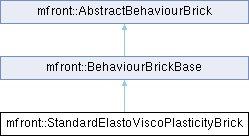
|
| static const char *const | computeStandardSystemOfImplicitEquations |
| | if the staggered algorithm is used to treat the porosity evolution, this variable gives the name of a boolean variable which can is false during the iteration of the staggered algorithm and set to true once the staggered algorithm has converged.
|
|
static const char *const | brokenVariable |
| | if the staggered approach is used, this is the name of an auxiliary state variable which states if the material point is totally damaged. If this variable is equal to 0, then the material is still able to sustain stress. If this variable is equal to 1, the material is totally damaged.
|
|
static const char *const | fixedPointConverged |
| | if the staggered approach is used, this is the name of a local variable which states if the staggered approach succeeded.
|
|
static const char *const | currentEstimateOfThePorosityIncrement |
| | if the staggered approach is used, this is the name of a local variable which holds the current estimate of the porosity increment.
|
|
static const char *const | nextEstimateOfThePorosityIncrement |
| | if the staggered approach is used, this is the name of a variable which holds a next estimate of the porosity increment.
|
|
static const char *const | nextEstimateOfThePorosityAtTheEndOfTheTimeStep |
| | if the staggered approach is used, this is the name of a variable which holds a next estimate of the porosity at the end of the time step.
|
|
static const char *const | porosityUpperBound |
| | this is the name of a variable which holds the upper bound of the porosity.
|
|
static const char *const | porosityUpperBoundSafetyFactor |
| | this is the name of a parameter which holds a safety factor for the porosity upper bound, because most of the stress criteria becomes singular when the associated upper bound is reached.
|
|
static const char *const | porosityUpperBoundSafetyFactorForFractureDetection |
| | this is the name of a parameter which holds a safety factor for the porosity upper bound when trying to detect the fracture of the material.
|
|
static const char *const | differenceBetweenSuccessiveEstimatesOfThePorosityIncrement |
| | if the staggered approach is used, this is the name of a variable which holds the difference between the new and the current estimates of the porosity increment.
|
|
static const char *const | staggeredSchemeConvergenceCriterion |
| | if the staggered approach is used, this is the name of a parameter which holds the value of criterion on the difference between the new and the current estimates of the porosity increment used to stop the staggered scheme.
|
|
static const char *const | staggeredSchemeIterationCounter |
| | if the staggered approach is used, this is the name of a local variable which holds the number of iterations of the staggered scheme already performed.
|
|
static const char *const | maximumNumberOfIterationsOfTheStaggeredScheme |
| | if the staggered approach is used, this is the name of a parameter which holds the maximum number of iterations of the staggered scheme.
|
|
static const char *const | staggeredSchemeBissectionAlgorithm |
| | if the staggered approach is used, this is the name of a instance of the tfel::math::BissectionAlgorithmBase class.
|
|
static const char *const | staggeredSchemeAitkenAccelerationAlgorithm |
| | if the staggered approach is used and that the acceleration algorithm used is the Aitken one, this is the name of a instance of the tfel::math::AitkenAccelerationAlgorithm class.
|
|
|
using | ModellingHypothesis = tfel::material::ModellingHypothesis |
| | a simple alias
|
|
using | Hypothesis = ModellingHypothesis::Hypothesis |
| | a simple alias
|
|
using | CxxTokenizer = tfel::utilities::CxxTokenizer |
| | a simple alias
|
|
using | tokens_iterator = CxxTokenizer::const_iterator |
| | a simple alias
|
| using | Parameters = std::map<std::string, std::string> |
|
using | Parameter = Parameters::value_type |
| | a simple alias
|
|
using | Data = tfel::utilities::Data |
| | a simple alias
|
|
using | DataMap = tfel::utilities::DataMap |
| | a simple alias
|
|
using | GlossaryEntry = tfel::glossary::GlossaryEntry |
| | a simple alias
|
| virtual void | checkOptionsNames (const DataMap &) |
| | check that the options names are in a given set of keys.
|
| virtual void | checkThatParameterHasNoValue (const Parameter &) const |
| | throw an exception if the given parameter has a value
|
| virtual void | addMaterialPropertyIfNotDefined (const std::string &, const std::string &, const GlossaryEntry &, const unsigned short=1u) const |
| | add a new material property
|
| virtual void | addMaterialPropertyIfNotDefined (const std::string &, const std::string &, const std::string &, const unsigned short=1u) const |
| | add a new material property
|
| virtual void | addExternalStateVariable (const std::string &, const std::string &, const unsigned short=1u) const |
| | add a new external state variable
|
| virtual void | addExternalStateVariable (const std::string &, const std::string &, const GlossaryEntry &, const unsigned short=1u) const |
| | add a new external state variable
|
| virtual void | addExternalStateVariable (const std::string &, const std::string &, const std::string &, const unsigned short=1u) const |
| | add a new external state variable
|
| virtual void | addLocalVariable (const std::string &, const std::string &, const unsigned short=1u) const |
| | add a new local variable
|
| virtual void | addParameter (const std::string &, const GlossaryEntry &e, const double) const |
| | add a new material property
|
| virtual void | addParameter (const std::string &, const GlossaryEntry &, const unsigned short, const double) const |
| | add a new material property
|
| virtual void | addParameter (const std::string &, const GlossaryEntry &, const unsigned short, const std::vector< double > &) const |
| | add a new material property
|
| virtual void | addParameter (const std::string &, const std::string &, const double) const |
| | add a new material property
|
| virtual void | addParameter (const std::string &, const std::string &, const unsigned short, const double) const |
| | add a new material property
|
| virtual void | addParameter (const std::string &, const std::string &, const unsigned short, const std::vector< double > &) const |
| | add a new material property
|
|
AbstractBehaviourDSL & | dsl |
| | calling domain specific language
|
|
BehaviourDescription & | bd |
| | mechanical behaviour description of which the BehaviourBrick acts
|
The StandardElastoViscoPlasticityBrick is meant to describe a behaviour based on:
- a stress potential describing how the stress is computed. The most used one will probably be the Hooke stress potential.
- a list of inelastic flows which describe how inelastic strains evolve.
| const char* const mfront::StandardElastoViscoPlasticityBrick::computeStandardSystemOfImplicitEquations |
|
static |
if the staggered algorithm is used to treat the porosity evolution, this variable gives the name of a boolean variable which can is false during the iteration of the staggered algorithm and set to true once the staggered algorithm has converged.
The rationale behing this is that the exact jacobian of the full system of implicit equations is required to compute the consistent tangent operator. Thus, once the staggered algorithm has converged, this jacobian must be built. This flag allows to switch from a reduced system of equations to the full system of equations.