Loading...
Searching...
No Matches
abaqus::AbaqusExplicitInterface< H, T, Behaviour > Class Template Reference
This class create an interface between a behaviour class and the abaqus finite element code. More...
#include </home/runner/work/tfel/tfel/mfront/include/MFront/Abaqus/AbaqusExplicitInterface.hxx>
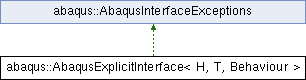
Inheritance diagram for abaqus::AbaqusExplicitInterface< H, T, Behaviour >:
Classes | |
| struct | StiffnessOperatorInitializer |
| structure in charge of initializing the stiffness operator More... | |
| struct | ThermalExpansionCoefficientTensorInitializer |
| structure in charge of initializing the stiffness operator More... | |
| struct | DoNothingInitializer |
| place holder for tag dispatching More... | |
| struct | InternalEnergyComputer |
| structure in charge of calling the computeInternalEnergy method More... | |
| struct | DissipatedEnergyComputer |
| structure in charge of calling the computeDissipatedEnergy method More... | |
| struct | DoNothingEnergyComputer |
| place holder for tag dispatching More... | |
Public Types | |
| using | MechanicalBehaviourBase = tfel::material::MechanicalBehaviourBase |
| simple alias | |
| using | BV = Behaviour<H, T, false> |
| using | MTraits = tfel::material::MechanicalBehaviourTraits<BV> |
| using | ATraits = AbaqusTraits<BV> |
| using | SInitializer |
| using | AInitializer |
| using | IEnergyComputer |
| using | DEnergyComputer |
Static Public Member Functions | |
| static TFEL_ABAQUS_INLINE2 int | computeElasticPrediction (T *const D, const AbaqusExplicitData< T > &d) |
| static TFEL_ABAQUS_INLINE2 int | computeElasticPrediction2 (T *const D, const AbaqusExplicitData< T > &d) |
| template<typename StreeFreeExpansionHandler> | |
| static TFEL_ABAQUS_INLINE2 int | integrate (tfel::math::stensor< N, T > &s, const AbaqusExplicitData< T > &d, const tfel::math::stensor< N, T > &e, const tfel::math::stensor< N, T > &de, const StreeFreeExpansionHandler &sfeh) |
| integrate a behaviour written at small strain | |
| static TFEL_ABAQUS_INLINE2 int | integrate (tfel::math::stensor< N, T > &s, const AbaqusExplicitData< T > &d, const tfel::math::tensor< N, T > &F0, const tfel::math::tensor< N, T > &F1) |
| integrate a behaviour written at small strain | |
Static Public Attributes | |
| static constexpr unsigned short | N |
| space dimension | |
| static constexpr bool | bs = ATraits::requiresStiffnessTensor |
| static constexpr bool | ba |
| static constexpr bool | bi = MTraits::hasComputeInternalEnergy |
| static constexpr bool | bd = MTraits::hasComputeDissipatedEnergy |
Additional Inherited Members | |
| Static Protected Member Functions inherited from abaqus::AbaqusInterfaceExceptions | |
| static void | throwInvalidTensorSize (const std::string &, const unsigned short n1, const AbaqusInt n2) |
| throw an AbaqusException. This method shall be called when the number of components of symmetric tensors for the current hypothesis does not match the the number of components of symmetric tensors given by Abaqus/Standard | |
| static void | throwUnMatchedNumberOfMaterialProperties (const std::string &, const unsigned short n1, const AbaqusInt n2) |
| throw an AbaqusException. This method shall be called when the number of materials properties declared by the behaviour and the number of materials properties declared by the interface does not match. | |
| static void | throwUnMatchedNumberOfStateVariables (const std::string &, const unsigned short n1, const AbaqusInt n2) |
| throw an AbaqusException. This method shall be called when the number of state variables declared by the behaviour and the number of state variables declared by the interface does not match. | |
| static void | treatAbaqusException (const std::string &, const AbaqusException &) |
| display the error message out of an AbaqusException to the standard output. | |
| static void | treatMaterialException (const std::string &, const tfel::material::MaterialException &) |
| display the error message out of a material exception to the standard output. | |
| static void | treatTFELException (const std::string &, const tfel::exception::TFELException &) |
| display the error message out of a generic tfel exception to the standard output. | |
| static void | treatStandardException (const std::string &, const std::exception &) |
| display the error message out of a generic standard exception to the standard output. | |
| static void | treatUnknownException (const std::string &) |
| display the error message when an unknown exception is caught | |
| static void | throwNegativeTimeStepException (const std::string &) |
| throw an AbaqusException if the time step is negative | |
| static void | throwPredictionComputationFailedException (const std::string &) |
| throw an AbaqusException if the prediction computation failed | |
| static void | throwConsistentTangentOperatorIsNotAvalaible (const std::string &) |
| throw an AbaqusException if the a consistent tangent operator has to been requested and that the behaviour does not provide one. | |
| static void | throwPredictionOperatorIsNotAvalaible (const std::string &) |
| throw an AbaqusException if the a prediction operator has to been requested and that the behaviour does not provide one. | |
| static void | throwUnsupportedStressFreeExpansionException (const std::string &) |
| display an error message if the behaviour shall handle stress free expansion and that the umat interface can't | |
| static void | displayUnsupportedHypothesisMessage () |
| display an error message if the value of the NTENS parameter is not valid | |
Detailed Description
template<tfel::material::ModellingHypothesis::Hypothesis H, typename T, template< tfel::material::ModellingHypothesis::Hypothesis, typename, bool > class Behaviour>
class abaqus::AbaqusExplicitInterface< H, T, Behaviour >
This class create an interface between a behaviour class and the abaqus finite element code.
- Note
- : most of branching is done at compile-time. to the very exeception of the stress-free expansion which are handled through two functions pointers which take into account the specificities of finite strain strategy used. The choice of introducing those runtime-functions comes from the fact that we did not want a code duplication between two different finite strain strategies (to reduce both compile-time and library size).
Member Typedef Documentation
◆ AInitializer
template<tfel::material::ModellingHypothesis::Hypothesis H, typename T, template< tfel::material::ModellingHypothesis::Hypothesis, typename, bool > class Behaviour>
| using abaqus::AbaqusExplicitInterface< H, T, Behaviour >::AInitializer |
Initial value:
typename std::conditional<ba,
DoNothingInitializer>::type
place holder for tag dispatching
Definition Abaqus/AbaqusExplicitInterface.hxx:94
structure in charge of initializing the stiffness operator
Definition Abaqus/AbaqusExplicitInterface.hxx:83
◆ DEnergyComputer
template<tfel::material::ModellingHypothesis::Hypothesis H, typename T, template< tfel::material::ModellingHypothesis::Hypothesis, typename, bool > class Behaviour>
| using abaqus::AbaqusExplicitInterface< H, T, Behaviour >::DEnergyComputer |
Initial value:
typename std::conditional<bd,
DoNothingEnergyComputer>::type
structure in charge of calling the computeDissipatedEnergy method
Definition Abaqus/AbaqusExplicitInterface.hxx:121
place holder for tag dispatching
Definition Abaqus/AbaqusExplicitInterface.hxx:132
◆ IEnergyComputer
template<tfel::material::ModellingHypothesis::Hypothesis H, typename T, template< tfel::material::ModellingHypothesis::Hypothesis, typename, bool > class Behaviour>
| using abaqus::AbaqusExplicitInterface< H, T, Behaviour >::IEnergyComputer |
Initial value:
typename std::
conditional<bi, InternalEnergyComputer, DoNothingEnergyComputer>::type
◆ SInitializer
template<tfel::material::ModellingHypothesis::Hypothesis H, typename T, template< tfel::material::ModellingHypothesis::Hypothesis, typename, bool > class Behaviour>
| using abaqus::AbaqusExplicitInterface< H, T, Behaviour >::SInitializer |
Initial value:
typename std::conditional<bs,
DoNothingInitializer>::type
structure in charge of initializing the stiffness operator
Definition Abaqus/AbaqusExplicitInterface.hxx:73
Member Function Documentation
◆ computeElasticPrediction()
template<tfel::material::ModellingHypothesis::Hypothesis H, typename T, template< tfel::material::ModellingHypothesis::Hypothesis, typename, bool > class Behaviour>
|
inlinestatic |
- Parameters
-
[out] D elastic stiffness [out] d data
simple alias
◆ computeElasticPrediction2()
template<tfel::material::ModellingHypothesis::Hypothesis H, typename T, template< tfel::material::ModellingHypothesis::Hypothesis, typename, bool > class Behaviour>
|
inlinestatic |
- Parameters
-
[out] D elastic stiffness [out] d data
simple alias
◆ integrate() [1/2]
template<tfel::material::ModellingHypothesis::Hypothesis H, typename T, template< tfel::material::ModellingHypothesis::Hypothesis, typename, bool > class Behaviour>
template<typename StreeFreeExpansionHandler>
|
inlinestatic |
integrate a behaviour written at small strain
- Parameters
-
[out/in] s: stress tensor [out] d data [out] e strain tensor [out] de strain tensor increment
simple alias
◆ integrate() [2/2]
template<tfel::material::ModellingHypothesis::Hypothesis H, typename T, template< tfel::material::ModellingHypothesis::Hypothesis, typename, bool > class Behaviour>
|
inlinestatic |
integrate a behaviour written at small strain
- Parameters
-
[out/in] s: stress tensor [out] d data [out] e strain tensor [out] de strain tensor increment
simple alias
Member Data Documentation
◆ ba
template<tfel::material::ModellingHypothesis::Hypothesis H, typename T, template< tfel::material::ModellingHypothesis::Hypothesis, typename, bool > class Behaviour>
|
staticconstexpr |
Initial value:
=
ATraits::requiresThermalExpansionCoefficientTensor
◆ N
template<tfel::material::ModellingHypothesis::Hypothesis H, typename T, template< tfel::material::ModellingHypothesis::Hypothesis, typename, bool > class Behaviour>
|
staticconstexpr |
Initial value:
=
Definition ModellingHypothesis.hxx:82
space dimension
The documentation for this class was generated from the following file: