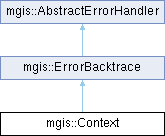
a class used to pass an execution context to most methods of MGIS and gather information (error, logs, profiling).
More...
#include </home/runner/work/MFrontGenericInterfaceSupport/MFrontGenericInterfaceSupport/include/MGIS/Context.hxx>
Classes | |
| struct | FailureHandler |
Public Types | |
| enum | FailureHandlerPolicy { ABORT , RAISE } |
 Public Types inherited from mgis::ErrorBacktrace Public Types inherited from mgis::ErrorBacktrace | |
| using | ErrorReportFunction = std::string(*)(const int) |
| brief a simple alias | |
| using | ErrorReport = std::variant< const char *, std::pair< int, ErrorReportFunction >, std::string > |
| a simple alias listing the main way to report an error. | |
Public Member Functions | |
| Context () noexcept | |
| default constructor | |
| Context (const ContextInitializer &) noexcept | |
| constructor for an initializer | |
| Context (Context &&)=delete | |
| Context (const Context &)=delete | |
| Context & | operator= (Context &&)=delete |
| Context & | operator= (const Context &)=delete |
| const VerbosityLevel & | getVerbosityLevel () const noexcept |
| void | setVerbosityLevel (const VerbosityLevel) noexcept |
| change the level of verbosity | |
| void | enableProfiling (const bool) noexcept |
| enable or disable profiling | |
| bool | isProfilingEnabled () const noexcept |
| ProfilingSection | startNewProfiling (std::string, bool) noexcept |
| start a new profiling section | |
| void | pushProfilingNode (std::string) noexcept |
| push a new profiling node into the current execution stack | |
| void | popProfilingNode (double) noexcept |
| pop the current profiling node from the execution stack and accumulate time | |
| const ProfilingData & | getProfilingResultTree () const noexcept |
| template<FailureHandlerPolicy policy = FailureHandlerPolicy::RAISE> | |
| FailureHandler< policy > | getFailureHandler () |
| FailureHandler< FailureHandlerPolicy::RAISE > | getThrowingFailureHandler () noexcept |
| FailureHandler< FailureHandlerPolicy::ABORT > | getFatalFailureHandler () noexcept |
| void | setLogStream (std::ostream &) noexcept |
| set the current log stream. | |
| void | setLogStream (std::shared_ptr< std::ostream >) noexcept |
| set the current log stream. | |
| std::shared_ptr< std::ostream > | getLogStreamPointer () const noexcept |
| void | resetLogStream () noexcept |
| reset the default log stream | |
| void | disableLogStream () noexcept |
| disable the default log stream | |
| std::ostream & | log () noexcept |
| template<typename... Args> | |
| std::ostream & | log (const VerbosityLevel, Args &&...) noexcept |
display the given arguments in the log stream if the current verbosity level (as returned by the getVerbosityLevel method) is greater than a minimal one. | |
| template<typename... Args> | |
| void | warning (Args &&...) noexcept |
a simple wrapper around the log method to print a warning | |
| template<typename... Args> | |
| void | debug (Args &&...) noexcept |
a simple wrapper around the log method which sets the minimun verbosity level to verboseDebug | |
| ~Context () noexcept override | |
| destructor | |
| template<typename... Args> | |
| std::ostream & | log (const VerbosityLevel l, Args &&...args) noexcept |
| template<typename... Args> | |
| void | warning (Args &&...args) noexcept |
| template<typename... Args> | |
| void | debug (Args &&...args) noexcept |
| Public Member Functions inherited from mgis::ErrorBacktrace | |
| void | assertOrTerminate (const bool, const char *const) |
assert that the given boolean is true. If false, terminate is called. | |
| void | assertOrTerminate (const bool, const ErrorReport) |
assert that the given boolean is true. If false, terminate is called. | |
| void | terminate (const char *const) |
| terminate the excution after displaying the given error message | |
| void | terminate (const ErrorReport) |
| terminate the excution after displaying the given error message | |
| InvalidResult | registerErrorMessage (const char *const) final |
| register a new error message | |
| InvalidResult | registerErrorMessage (const ErrorReport) noexcept |
| register a new error message | |
| template<typename ReturnType > requires (internal::InvalidValueTraits<ReturnType>::isSpecialized) | |
| ReturnType | registerErrorMessage (const char *const) |
| register a new error message | |
| template<typename ReturnType > requires (internal::InvalidValueTraits<ReturnType>::isSpecialized) | |
| ReturnType | registerErrorMessage (const ErrorReport) noexcept |
| register a new error message | |
| InvalidResult | registerErrorMessageWithoutSourceLocation (const ErrorReport) noexcept |
| register a new error message | |
| void | clearErrorMessages () noexcept |
| remove the error messages | |
| std::string | getErrorMessage (const bool=true) noexcept |
| std::string | getRawErrorMessage (const bool=true) noexcept |
| bool | empty () const noexcept |
| ~ErrorBacktrace () noexcept override | |
| destructor | |
| Public Member Functions inherited from mgis::AbstractErrorHandler | |
| virtual constexpr | ~AbstractErrorHandler ()=default |
| destructor | |
Additional Inherited Members | |
| Static Public Member Functions inherited from mgis::ErrorBacktrace | |
| static void | setErrorReportingAsFatal () noexcept |
| specify if error reporting shall be fatal | |
| static void | unsetErrorReportingAsFatal () noexcept |
| specify if error reporting shall be fatal | |
| static void | abort (std::string_view) |
| call the terminate handler | |
Detailed Description
a class used to pass an execution context to most methods of MGIS and gather information (error, logs, profiling).
The default logging stream is the one returned by the mgis::getDefaultLogStream free function.
Constructor & Destructor Documentation
◆ Context() [1/2]
|
noexcept |
default constructor
The verbositiy level is initialized by calling the getDefaultVerbosityLevel function.
◆ Context() [2/2]
|
noexcept |
constructor for an initializer
- Parameters
-
[in] i initializer
Member Function Documentation
◆ debug()
|
noexcept |
a simple wrapper around the log method which sets the minimun verbosity level to verboseDebug
- Template Parameters
-
Args types of the arguments
- Parameters
-
[in] args streamed object
- Note
- note nothing is displayed if the current verbositiy level is below
verboseDebug
◆ disableLogStream()
|
noexcept |
disable the default log stream
- Note
- logging is disable by creating a no-op output stream
◆ enableProfiling()
|
noexcept |
enable or disable profiling
- Parameters
-
[in] b a boolean value stating whether profiling shall be enabled
- Note
- when profiling is disabled, profiling sections introduce almost no overhead.
◆ getFailureHandler()
|
inline |
- Returns
- a failure handler
- Template Parameters
-
policy policy used to treat a failure
- Note
- the context must outlive the failure hander
◆ getFatalFailureHandler()
|
inlinenoexcept |
- Returns
- a failure handler aborting the execution in case of failure
◆ getLogStreamPointer()
|
noexcept |
- Returns
- a pointer to a log stream. This pointer may be null.
◆ getProfilingResultTree()
|
noexcept |
- Returns
- the root node of the profiling results tree gathered during execution
◆ getThrowingFailureHandler()
|
inlinenoexcept |
- Returns
- a failure handler throwing exception in case of failure
◆ getVerbosityLevel()
|
noexcept |
- Returns
- the verbosity level
◆ isProfilingEnabled()
|
noexcept |
- Returns
- true if profiling is enabled, false otherwise
◆ log() [1/2]
|
noexcept |
- Returns
- the current log stream
- Note
- if no log stream is set, the default one is returned. See
getDefaultLogStreamfor details.
◆ log() [2/2]
|
noexcept |
display the given arguments in the log stream if the current verbosity level (as returned by the getVerbosityLevel method) is greater than a minimal one.
- Template Parameters
-
Args types of the arguments
- Returns
- the current log stream
- Parameters
-
[in] l minimal verbosity level [in] args streamed object
- Note
- note nothing is displayed if the current verbositiy level is below the first argument
◆ popProfilingNode()
|
noexcept |
pop the current profiling node from the execution stack and accumulate time
- Parameters
-
[in] dt execution time of the section in seconds
- Note
- this method is meant to be called internally by the
Profilingclass during its destruction.
◆ pushProfilingNode()
|
noexcept |
push a new profiling node into the current execution stack
- Parameters
-
[in] name name of the profiling section
- Note
- this method is meant to be called internally by the
Profilingclass during its construction.
◆ setLogStream() [1/2]
|
noexcept |
set the current log stream.
- Parameters
-
[in] s log stream
- Note
- the user is responsible for ensuring that the given object is alive
◆ setLogStream() [2/2]
|
noexcept |
set the current log stream.
- Parameters
-
[in] s log stream
- Note
- if an empty shared pointer is given, the log stream is reset to the default one, i.e. the one returned by the
mgis::getDefaultLogStreamfree function.
◆ setVerbosityLevel()
|
noexcept |
change the level of verbosity
- Parameters
-
[in] l the new verbose level
◆ startNewProfiling()
|
noexcept |
start a new profiling section
- Parameters
-
[in] name name of the profiling section [in] enabled boolean stating whether this profiling section shall effectively collect timing information
- Returns
- a profiling section object
- Note
- the returned object relies on RAII semantics: timing starts during construction and stops during destruction.
◆ warning()
|
noexcept |
a simple wrapper around the log method to print a warning
- Template Parameters
-
Args types of the arguments
- Parameters
-
[in] args streamed object
The documentation for this struct was generated from the following files: